
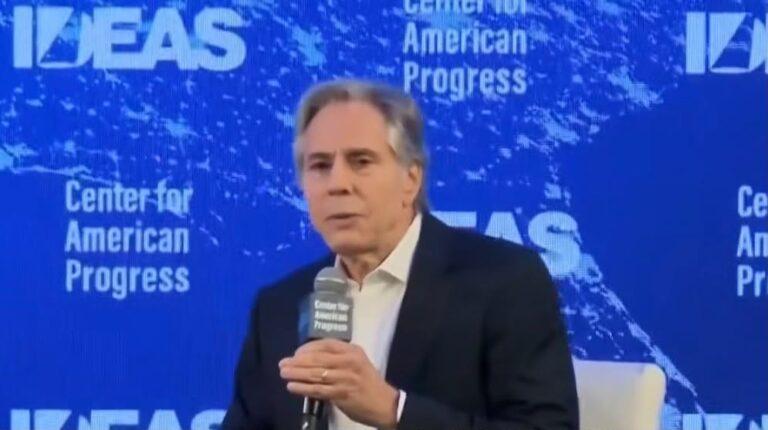
In a conversation that quickly drew attention among diplomats, political analysts, and foreign policy observers, Former U.S. Secretary of State Antony Blinken argued that some American leaders increasingly see the world as divided into “spheres of influence,” where major powers dominate weaker nations inside their own regions.
“I think we have a president who divides the world up into what he sees as spheres of influence,” Blinken said, referring to President Donald Trump.
“The big countries get to do what they want in their part of the world, and the smaller countries have to suffer what they will.”
The remarks were widely interpreted as criticism of Trump’s foreign policy approach toward China during a period of rising geopolitical tension between Washington and Beijing.
But beyond the political criticism itself, Blinken’s comments revealed something deeper inside American strategic thinking: fear that China is no longer simply competing with the United States economically, but attempting to redesign the balance of global power.
“This is the one country that has the capacity as well as the intent to reshape the international system,” Blinken said.
That line immediately became one of the most discussed parts of the interview because it reflects a growing belief inside Western security circles that China’s ambitions now extend far beyond trade, manufacturing, or Taiwan.
For years, American officials described China mainly as a competitor. Today, language coming from Washington increasingly frames Beijing as a long-term systemic challenge capable of changing international institutions, financial systems, military alliances, and even technological standards.
Blinken also warned that influence inside one region rarely remains contained.
“The challenge is what happens within one sphere of influence almost never stays there,” he said. “Countries are always looking for more.”
That argument reflects long-standing American fears about how global superpowers expand influence step by step, economically first, militarily later, and politically afterward.
China’s expanding presence across Africa, Latin America, the Middle East, and parts of Asia has intensified those debates inside Washington. Through infrastructure financing, technology exports, trade agreements, and diplomatic partnerships, Beijing has steadily increased its global reach while presenting itself as an alternative to Western-led institutions.
Critics of Trump’s approach fear that reducing American engagement in Asia could leave smaller countries vulnerable to Chinese pressure, especially in disputes involving Taiwan, the South China Sea, and regional security alliances.
Others, however, argue that the United States itself historically operated through spheres of influence and accuse Washington of reacting differently only because another power is now capable of challenging its dominance.
That debate has become increasingly visible as the world moves away from the unipolar system that emerged after the Cold War, when the United States stood as the uncontested global superpower.
What makes Blinken’s remarks especially important is that they reflect a broader transformation taking place inside American foreign policy thinking itself. The conversation in Washington is no longer about whether China will become powerful. It is now about how far that power could eventually reach.
Unlike previous rivals faced by the United States, many American strategists believe China possesses something more dangerous: the economic scale, technological capacity, and political patience to compete for decades without collapsing under the pressure of confrontation. That is why comments like Blinken’s are receiving attention far beyond American politics.