


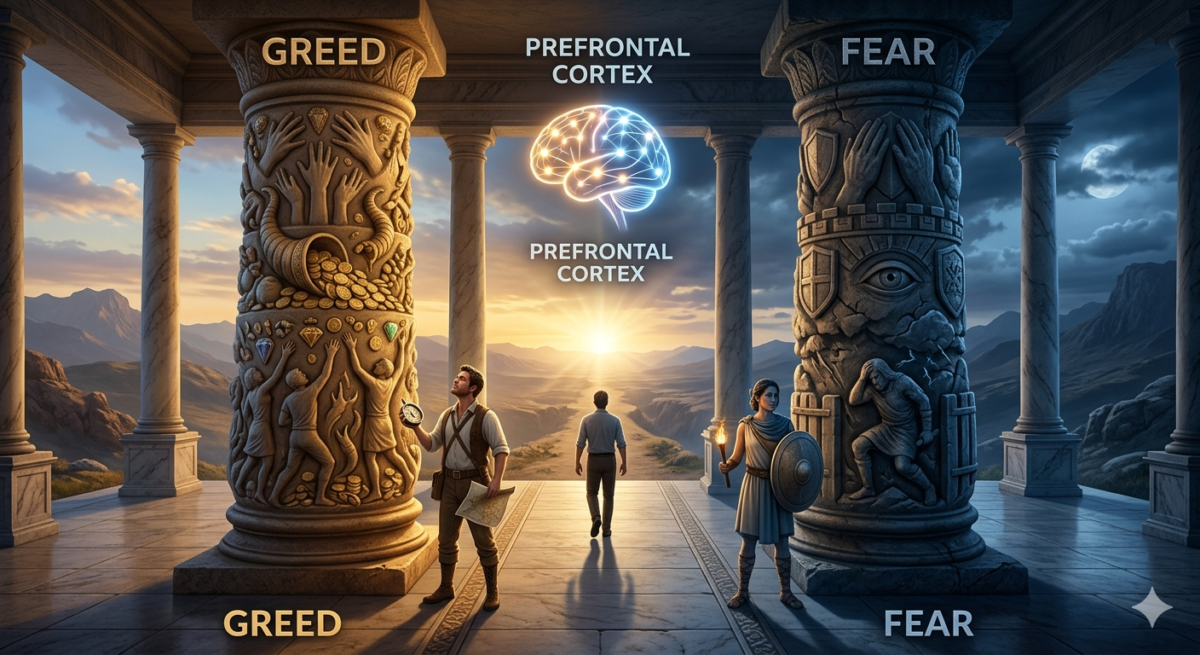
Human life is largely defined by the constant interplay between greed and fear. These two core behaviors dictate how individuals process information and react to their circumstances.
Greed often manifests as an insatiable desire for more, reaching for things beyond what a person currently possesses or can realistically manage. In contrast, fear typically stems from the unknown, characterized by anxiety over events that have not yet occurred or a persistent worry that things will not go according to plan.
The ability to navigate these emotions is often what distinguishes successful individuals from those who struggle.
Success is not necessarily the absence of these feelings, but rather the mastery of them. Successful people maintain their composure and exercise patience when the impulse of greed arises; instead of acting on a whim, they move with discipline and foresight.
Furthermore, when fear begins to circulate, successful individuals do not succumb to panic. Instead, they respond by strategically protecting their assets and progress. While unsuccessful people may allow these two forces to drive them toward reactive or irrational decisions, the successful mind remains grounded, balancing the drive for growth with a calculated defense of what has already been built.
From the perspective of behavioral economics and evolutionary psychology, fear and greed are not merely “faults“; they are fundamental survival mechanisms.
Fear, often associated with the “fight or flight” response, was designed to keep our ancestors safe from immediate physical threats. In a modern context, that same biological alarm system triggers when we worry about financial loss or social failure. Similarly, the “seeking” system was originally an evolutionary advantage that encouraged humans to gather resources like food and shelter during times of plenty to survive future scarcity.
In modern decision-making, these emotions often lead to cognitive biases. For example, greed is closely linked to overconfidence bias, where an individual believes they can beat the odds, leading them to take unmanageable risks. Fear is the engine behind loss aversion, a psychological phenomenon where the pain of losing something is perceived as twice as powerful as the joy of gaining something of equal value.
Successful people differentiate themselves by utilizing the prefrontal cortex, the rational part of the brain, to override these primal signals from the amygdala, allowing for an objective strategy rather than an emotional reaction.
References for Further Understanding
. “Thinking, Fast and Slow” by Daniel Kahneman: A foundational text by a Nobel laureate that explains the “dual-process” model of the brain; how our fast, emotional “System 1” (where greed and fear reside) often clashes with our slow, logical “System 2.”
. “The Psychology of Money” by Morgan Housel: This book provides excellent modern parables on how ego, greed, and fear influence financial success more than technical knowledge does.
. “The Intelligent Investor” (Chapter 8) by Benjamin Graham: While primarily a finance book, it famously describes “Mr. Market,” an imaginary character driven by manic greed and depressive fear, and teaches how to remain the master of your emotions rather than their servant.
“Predictably Irrational” by Dan Ariely: An engaging look at how humans repeatedly make the same illogical mistakes due to emotional triggers and how to recognize those patterns in yourself.
About The Author