
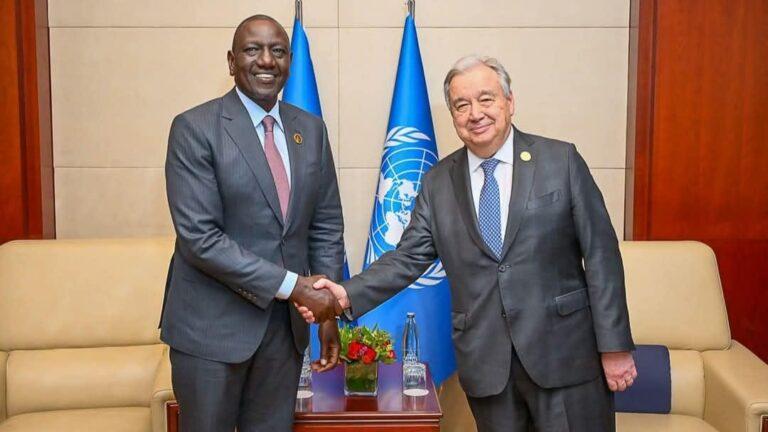
The Secretary-General of the United Nations, António Guterres, has publicly backed Kenyan President William Ruto in demanding major reforms to the United Nations Security Council, saying Africa deserves permanent representation in the powerful global body.
Speaking during a special interview with Citizen TV Kenya, Guterres said the current structure of the Security Council no longer reflects the realities of the modern world.
“In the Security Council, we have three European countries as permanent members: France, the United Kingdom and Russia. We do not have a single African country, no Latin American country, and only one Asian country,” Guterres said.
He argued that the absence of Africa from permanent representation inside the UN’s most powerful decision-making organ cannot continue in today’s geopolitical environment.
“It is clear this situation no longer corresponds to the world of today,” he added.
“Having two African countries as permanent members of the Security Council is essential to correct this historical injustice inherited from colonialism.”
The UN Security Council currently consists of five permanent members with veto powers: the United States, Russia, China, France, and the United Kingdom.
Africa, despite being home to 54 countries and more than 1.4 billion people, has never held a permanent seat with veto authority.
Guterres also criticized representation inside major global financial institutions, including the World Bank and the International Monetary Fund.
According to the UN chief, developing nations, especially African countries, continue to have limited influence in institutions that shape global economic policy.
“If you look at the World Bank and the IMF, developing countries, including African nations, are clearly underrepresented,” he said.
“That means the global financial system often ends up serving mainly the interests of wealthy countries.”
Ruto has emerged as one of Africa’s strongest voices pushing for reform inside the United Nations.
The Kenyan president has repeatedly argued that Africa should receive at least two permanent Security Council seats with full veto powers similar to those of existing permanent members.
Calls for reform of the Security Council have intensified in recent years as critics argue the institution still reflects the global power structure that existed after World War II rather than current geopolitical realities.
African leaders have long argued that the continent remains heavily affected by decisions made by the Security Council despite lacking permanent influence over those decisions.
Diplomats say changing the structure of the Security Council would require approval from current permanent members, making reforms politically difficult despite growing international support.