

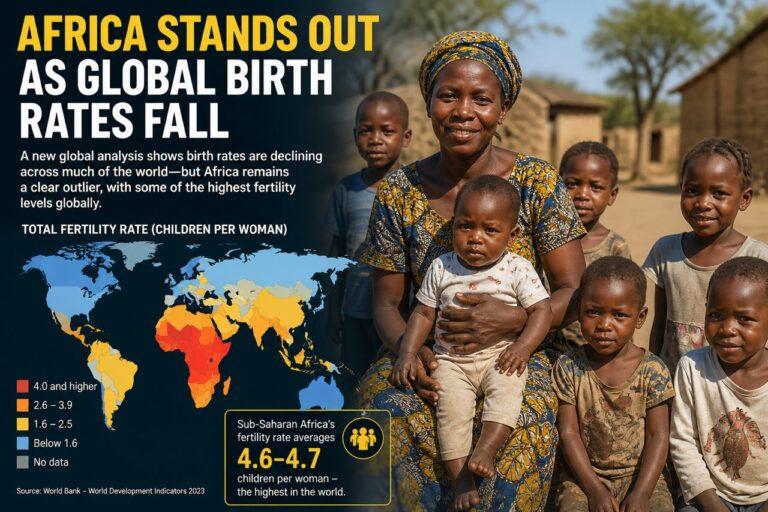
A new global analysis shows birth rates are declining across much of the world, but Africa remains a clear outlier, with some of the highest fertility levels globally despite widespread economic challenges.
Data compiled by Visual Capitalist highlights a widening demographic gap between developed and developing regions, as countries in Europe, Asia and the Americas record falling fertility rates while much of Africa continues to see rapid population growth.
Across sub-Saharan Africa, women have an average of about 4.6 to 4.7 children, the highest rate in the world, compared to levels below the replacement rate of 2.1 in many developed countries.
The region now accounts for a growing share of global births, with projections suggesting Africa could represent more than half of all births worldwide by the end of the century.
Experts say the contrast is driven by a mix of economic and social factors. In wealthier countries, rising living costs, access to education, and widespread use of contraception have contributed to declining birth rates.
In contrast, many African countries remain in an earlier stage of demographic transition, where improvements in healthcare have reduced death rates but birth rates remain high, a dynamic often described as a “demographic trap.”
In such settings, larger families are often linked to economic survival. Children can be seen as a source of labour or long-term support, particularly in areas with limited social safety nets.
At the same time, limited access to family planning, lower levels of female education, and cultural expectations around family size continue to shape fertility patterns across the continent.
Despite this, data shows fertility rates in Africa are also beginning to decline gradually, though at a slower pace compared to other regions.
The trend presents a complex picture for policymakers. Rapid population growth can place pressure on healthcare systems, education, and employment, particularly in countries already facing economic strain.
Africa has the youngest population in the world, with a median age under 20, offering what economists describe as a possible “demographic dividend” if investments in education, jobs and infrastructure keep pace.
The challenge now is whether governments can turn that population growth into economic strength or whether rising numbers will deepen existing pressures on resources and public services.