Physical Address
Delta Corner Tower,
Waiyaki Way, Westlands, Nairobi, Kenya.
Contact us:
Email: info@todaysw.com
Physical Address
Delta Corner Tower,
Waiyaki Way, Westlands, Nairobi, Kenya.
Contact us:
Email: info@todaysw.com
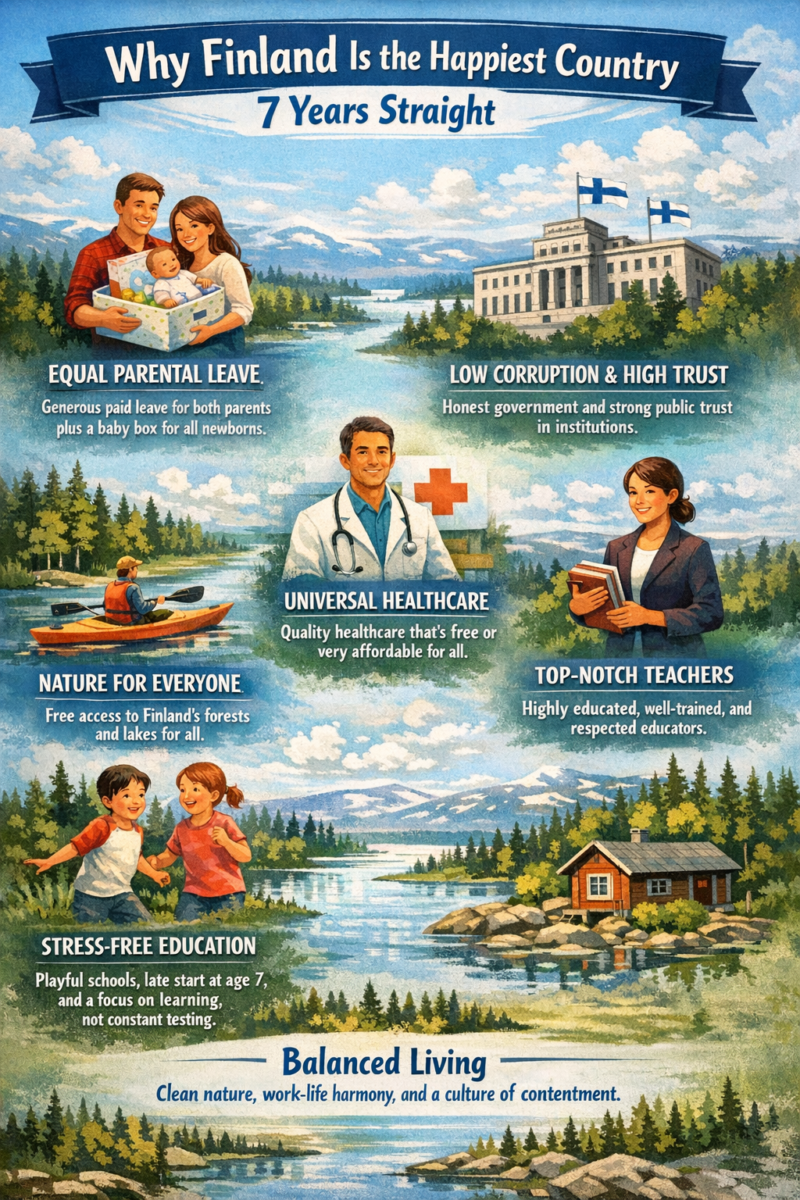
For nine years in a row, Finland has been ranked the happiest country in the world. Not the loudest. Not the richest. Not the most glamorous. It has that balance to the most essential needs that other places can not collect them all. That only makes Finland the most stable place to live a life.
The ranking, published annually in the World Happiness Report, doesn’t measure smiles or mood. It looks at something deeper on how life actually feels when you wake up, move through your day, and think about your future. It tracks trust, income, health, freedom, and the quiet presence or absence of stress.
And that’s where Finland stands out.
In Finland, life is built to reduce friction. Systems work the way people expect them to. You don’t spend energy fighting broken processes or worrying about sudden collapse. Healthcare is accessible. Education is steady. Government and Institutions are trusted. That trust, more than anything, changes how people experience everyday life. When you don’t constantly question whether things will fail you, your mind rests differently.
There’s also a cultural rhythm that doesn’t chase extremes. Success isn’t loudly performed. Wealth isn’t aggressively displayed. The pace is slower, more deliberate. People value space both physically and mentally. Silence isn’t awkward; it’s normal. Time alone isn’t loneliness; it’s balance.
Even the way Finland treats nature tells a bigger story. Forests, lakes, open land. These aren’t luxuries reserved for a few. They are part of daily life, protected by law and open to everyone. You can walk, breathe, exist without needing permission or money. That constant access to calm environments quietly shapes how people feel, even if they don’t talk about it.
Families are supported in ways that remove pressure early. Parenting isn’t treated as a private struggle you must survive alone. Time is given. Space is given. Help is built into the system. The result is not perfect families, but less overwhelmed ones.
The same philosophy carries into education. Children are not rushed into competition. They start later, learn at a steadier pace, and are allowed to develop without constant pressure. Yet somehow, outcomes remain strong. It’s a system that trusts the process instead of forcing results too early.
And then there’s the role of work. In many parts of the world, work stretches into identity of who you are, how you prove your worth. In Finland, work is important, but it doesn’t swallow life. There is a clearer boundary. When the day ends, it ends.
All of this adds up to something that doesn’t look dramatic from the outside. Finland doesn’t sell a dream. It doesn’t try to impress you.
But beneath that quiet surface, there’s a system that removes many of the daily anxieties people elsewhere learn to live with. Less fear of falling through the cracks. Less pressure to constantly prove yourself. Less chaos.