Physical Address
Delta Corner Tower,
Waiyaki Way, Westlands, Nairobi, Kenya.
Contact us:
Email: info@todaysw.com
Physical Address
Delta Corner Tower,
Waiyaki Way, Westlands, Nairobi, Kenya.
Contact us:
Email: info@todaysw.com
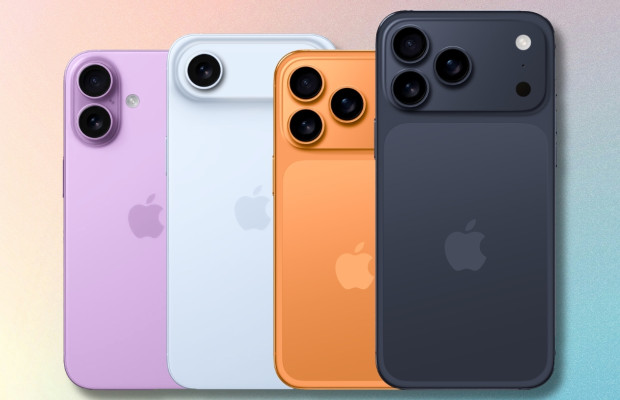
If you’ve been rocking an iPhone 14 Pro Max like me, the iPhone 17 series is Apple’s loudest invitation yet to step into the future. Launched this September, the lineup doesn’t just polish last year’s glass—it rethinks what a smartphone should feel like. From the muscle of the A19 Pro chip with its new vapor-chamber cooling, to the marathon battery life that finally kills charger anxiety, Apple is making sure you notice the leap. The cameras? Think less “upgraded phone” and more “pocket studio,” with triple 48 MP sensors and new filmmaking tools that blur the line between Hollywood gear and everyday shooting.
But here’s the catch—it looks different. Really different. Apple’s new full-width camera island has already sparked debates, with some calling it bold and others saying it veers too close to Android’s playbook. And for minimalists still mourning the loss of a simple black option, or users attached to physical SIMs, this might not feel like home at first glance. Still, between the slim and stylish new Air, the supercharged Pro models, and a base iPhone 17 that’s no slouch, the lineup feels like Apple throwing open the doors and saying: pick your future, we’ve built a version for you.
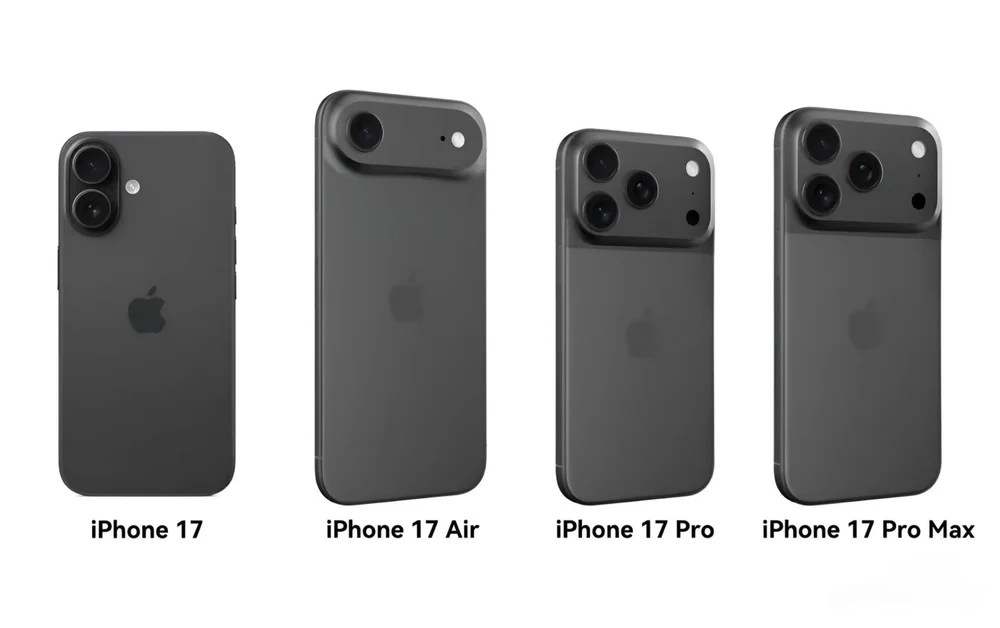
Apple has split the family into four distinct choices:
For context, the iPhone 14 Pro Max launched at $1,099 in 2022 with a base 128 GB option. The iPhone 17 line now skips that entry tier—storage begins at 256 GB, which feels future-proof but also bumps the starting cost.
Compared to the A16 Bionic inside the 14 Pro Max, the A19 Pro isn’t just faster—it’s smarter at staying fast. With vapor-chamber cooling, the Pro models handle gaming, editing, and multitasking up to 40% better sustained performance. As a 14 Pro Max user, you’ll immediately notice the difference in how the new chips shrug off heat and keep things running smooth, even during long 4K recording or hours of Call of Duty.
Apple claims:
That’s a real upgrade over the 14 Pro Max’s ~29 hours. And yes, fast-charging finally feels “fast”: 50% in 20 minutes with the right adapter.
The 14 Pro Max introduced the 48 MP sensor, but the iPhone 17 Pro series doubles down. You get triple 48 MP Fusion cameras with up to 8× optical-equivalent zoom, new ProRes RAW, Apple Log 2, and even genlock support—basically turning the phone into a professional camera rig.
Even the base iPhone 17 now carries dual 48 MP lenses, so you’re not stuck with outdated 12 MP sensors anymore. And the 18 MP Center Stage front camera feels like Apple admitting selfies and video calls deserve flagship treatment.
The “Air” is Apple’s thinnest phone ever—light, polished titanium, and just 5.6 mm thick. It’s the model for anyone who hates bulky pockets.
The Pro and Pro Max, though, wear the controversial full-width camera island. Some see it as a design risk, others as Apple chasing Android aesthetics. Coming from the 14 Pro Max’s sleek triple-lens cluster, it may take some getting used to.
Color choices are bold too: cosmic orange, deep blue, and silver—no black option this year.
Pros
Cons
If you want raw power and battery endurance, the Pro Max is your best bet. If you want something sleek but still premium, the Air feels like Apple experimenting in the best way. And even the base iPhone 17 finally feels flagship-worthy.