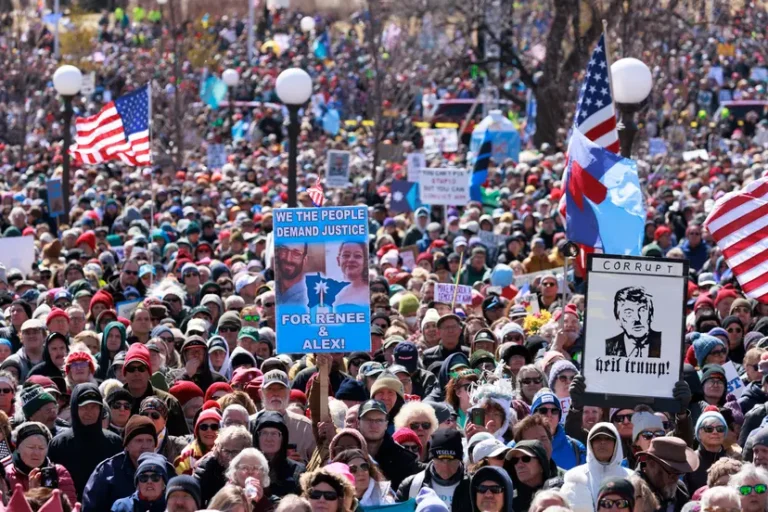
Thousands of Americans have taken to the streets in what some analysts are calling one of the biggest civilian protest waves in recent years, in response to an emergent movement called “No Kings,” taking hold across the nation.
Protests, against what appear to be President Donald Trump‘s policies, have seen massive turnout from big cities including New York, Los Angeles and Washington, D.C., reaching towns in all size groups, both rural and urban.
Protesters have carried strong placards, chanted loud, and voiced what they describe as a bullying type leadership and a focus on warmongering over citizen well being, under the main protest chant of “No Kings“.
Organizers say that there are three specific points which are being addressed.
The first is anti-war efforts. Protesters have been complaining loudly about the U.S.’s participation in the Middle East crisis, with much concern expressed about the prospects of being brought into war directly with Iran. Many demonstrators say continuing to move around in the Middle East will only put more people at risk and create worse conditions for the region.
Second, protesters are complaining about immigration laws. Citizens are upset with the increasingly stringent laws that are being brought about, in addition to the arrests of illegal aliens throughout the nation on an almost daily basis. Organizations against the laws say they are separating families and making people fear what will happen to them in immigrant communities.
The last point of contention is the high cost of living. Demonstrators are concerned that many low to middle income Americans can not keep up with the price of food, gas, and everyday needs.
Though the demonstrations were almost entirely peaceful (so far as of the publication) many police forces in towns where it occurred have monitored the crowds but had reported no large incidents or significant troubles.
The “No Kings” movement seems to be lacking a specific leader, being a “grassroots driven movement,” with much power from social media organization. Those involved believe that the lack of specific leader points to a larger distrust than can be traced to political party.