Physical Address
Delta Corner Tower,
Waiyaki Way, Westlands, Nairobi, Kenya.
Contact us:
Email: info@todaysw.com
Physical Address
Delta Corner Tower,
Waiyaki Way, Westlands, Nairobi, Kenya.
Contact us:
Email: info@todaysw.com
The United States has sent a small team of military personnel to Nigeria to bolster cooperation in counterterrorism operations against jihadist groups, marking an expansion of security collaboration.
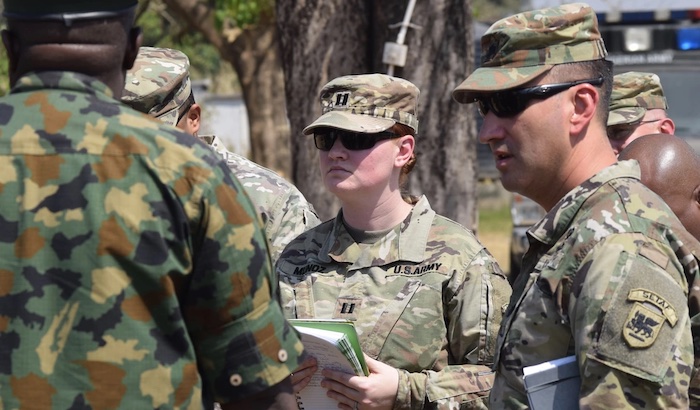
The U.S. has deployed a small contingent of military officers to Nigeria to support counterterrorism efforts against Islamist militant groups, officials announced Tuesday, underscoring deepening security cooperation between the two nations.
The deployment was confirmed by General Dagvin R.M. Anderson, head of the U.S. Africa Command (AFRICOM), who said Washington and Abuja agreed to increase collaboration after a series of high-level discussions, including a meeting between Anderson and Nigerian President Bola Tinubu in Rome last year.
The presence of U.S. forces follows airstrikes conducted by American forces in December 2025 targeting affiliates of the Islamic State in northwestern Nigeria — actions that marked a significant escalation in U.S. involvement in combating militant activity in the region.
General Anderson did not disclose details such as the exact number of personnel or specific operational roles, but said the team will bring “unique capabilities” from the United States to support Nigeria’s long-standing efforts against jihadist insurgencies, particularly in the north where groups such as the Islamic State West Africa Province (ISWAP) and Boko Haram remain active.
Nigeria has faced persistent security challenges for years, with extremist factions carrying out attacks on villages, kidnappings, and assaults on both civilians and security forces. While the Nigerian government rejects claims that these conflicts target specific religious communities, President Donald Trump’s administration has repeatedly cited violence against Christians as a key concern.
Defence officials in Abuja confirmed the U.S. team’s presence but did not detail its composition or mission activities. Analysts suggest that U.S. personnel will likely focus on intelligence sharing, reconnaissance support and advisory roles, providing capacities that complement Nigeria’s military operations.
The deployment reflects a deeper operational partnership following the American airstrikes last year, which marked one of the first times U.S. forces engaged militant targets on Nigerian soil at the government’s request. In addition to air support, U.S. surveillance flights over the region have been running since late November 2025, indicating sustained intelligence cooperation.
Security analysts see the move as part of a broader U.S. strategy to assist African nations grappling with jihadist insurgencies, even as Western military efforts in neighbouring regions like the Sahel have been scaled back. The strategy balances direct military engagement, where requested by host governments, with training, intelligence and logistical support designed to strengthen partner capabilities.