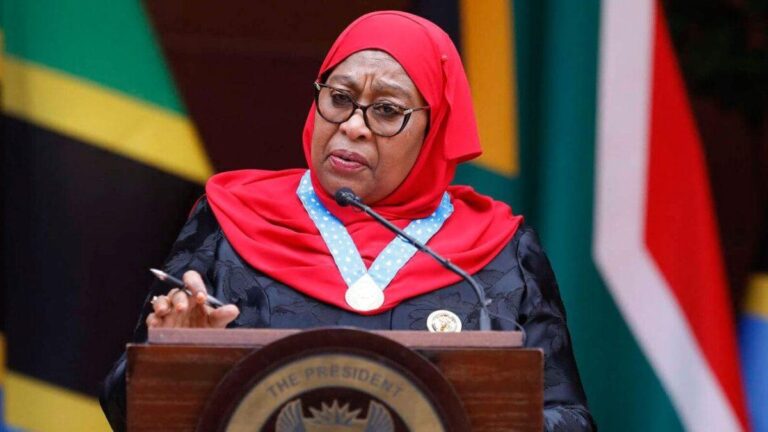
Tanzanian President Samia Suluhu Hassan has reaffirmed her government’s commitment to a non-aligned foreign policy, insisting that Tanzania will continue pursuing economic partnerships with all major global powers rather than siding with any geopolitical bloc.
Speaking to journalists accompanying her during her state visit to Russia, Samia said Tanzania’s interests are best served by maintaining strong relations with countries across Europe, North America, Asia, and Africa.
Her remarks come at a time when Tanzania’s growing engagement with Russia has attracted attention internationally, particularly after recent tensions with some Western partners over governance and human rights concerns.
“We do not choose who to work with. Anyone who can work with Tanzania is welcome to work with us,” Samia said.
The president rejected suggestions that strengthening ties with Moscow meant Tanzania was turning away from traditional Western partners.
“Europe is our trade partner. Europe buys many Tanzanian products, and we import many goods from them. Europe is also an important source of investment capital for Tanzania,” she said.
Samia also highlighted the country’s longstanding relationship with the United States.
“The United States is one of our biggest partners. The largest number of tourists visiting Tanzania comes from the United States. We also cooperate on many different projects, and more than 420 American companies are operating in Tanzania across various sectors,” she said.
The president noted that relations between Tanzania and Russia had remained relatively quiet for decades due to changes in global politics and international sanctions imposed on Moscow.
She explained that Tanzania’s economic reforms of the 1980s and its cooperation with international financial institutions also shaped the country’s external partnerships during that period.
“During the 70s and into the 80s, we entered programmes with the World Bank which influenced the partnerships we could pursue at the time,” Samia said.
She argued that today’s global economy requires countries to be more flexible and open to a wider range of partners.
“As global politics and economics continue to change, we as Tanzanians do not select who to work with. We gather opportunities from everyone who is willing to work with us. That is what we mean when we say we are non-aligned,” she added.
Samia’s comments come days after the European Parliament’s Foreign Affairs Committee called for the suspension of development assistance to Tanzania over concerns related to governance, human rights, and democratic freedoms.
The United States has also recently imposed sanctions on a senior Tanzanian police official over allegations linked to the treatment of political activists.
Despite those developments, the Tanzanian government has maintained that its relations with Western countries remain strong and that cooperation continues in trade, tourism, investment, and development projects.
Samia is in Russia on a state visit at the invitation of President Vladimir Putin. The two leaders met at the Kremlin this week, where they discussed bilateral relations, trade, investment, and other areas of cooperation.
Her government says the visit reflects Tanzania’s broader strategy of expanding economic opportunities with partners around the world while maintaining its longstanding policy of not aligning itself with competing global power blocs.