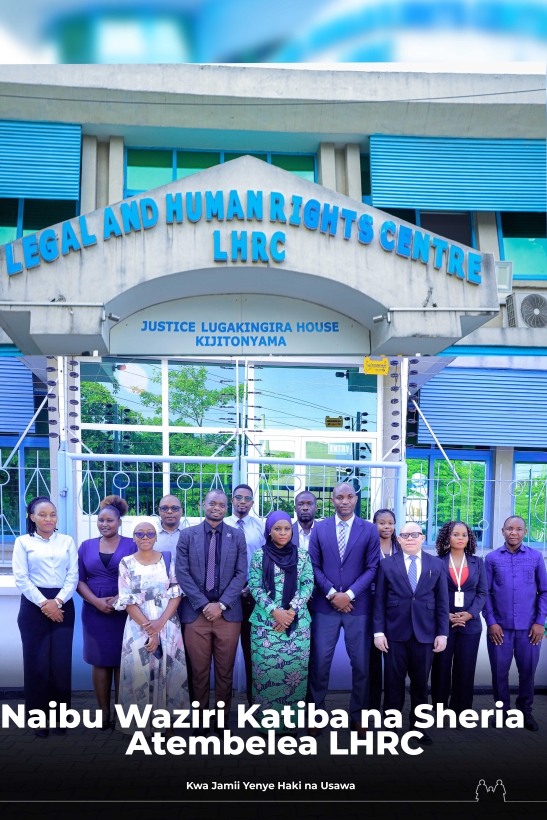
DAR ES SALAAM, Tanzania – The Deputy Minister for Constitutional and Legal Affairs, Hon. Zainab Athuman Katimba had unofficial meeting on Friday at the Legal and Human Rights Centre (LHRC) offices in Dar es Salaam to discuss on legal aid services and broaden access to justice throughout Tanzania.
According to LHRC, dialogues revolved around speeding up digitization of legal aid services, modern case-management tools for paralegals, and a stronger collaboration between civil society organizations and the government.
The Deputy Minister of the Ministry of Constitutional and Legal Affairs was updated about the obstacles confronting paralegals working in remote districts, such as lack of access to digital infrastructure, delays in document processing, and limited access to correctional facilities when dealing with prison inmates’ cases.
LHRC officers stated that through digital platforms, paralegals could submit reports, track case progress and have secure correspondence with supervisory advocates without extensive travel. In their view, improved connectivity and a central data system would reduce the workload and enhance monitoring of rights violations.
Prison access also proved to be a critical topic. Legal officers and accredited paralegals usually require permits to visit inmates which can hinder crucial immediate legal intervention. LHRC representatives advocated for simpler procedures and clearer guidelines for prompt visits, especially for pretrial detainees.
Government officials admitted that extending coverage for legal aid is a priority particularly in the wake of the enactment of Tanzania’s Legal Aid Act, which gives formal recognition to paralegals as participants in the delivery of justice, stipulating for collaboration between state institutions and accredited legal aid providers so as to increase access.
The LHRC has persistently championed the strengthening of community-based legal justice services arguing that, most Tanzanian citizens-especially those residing in rural areas-can no longer afford the costs of private lawyers and mostly depend on paralegals for mediation, administrative help with documents, and essential legal education.
Participants were also briefed on the potential of an interconnected reporting system among prisons, courts and legal aid offices to enhance efficiency in the tracking of cases and enhance transparency, claiming it would minimize delays.
The Deputy Minister reportedly seemed receptive to continued work and technical support from the Ministry to civil society organizations involved in the legal aid sphere. No changes were officially declared during the meeting.